A Playbook for the Community
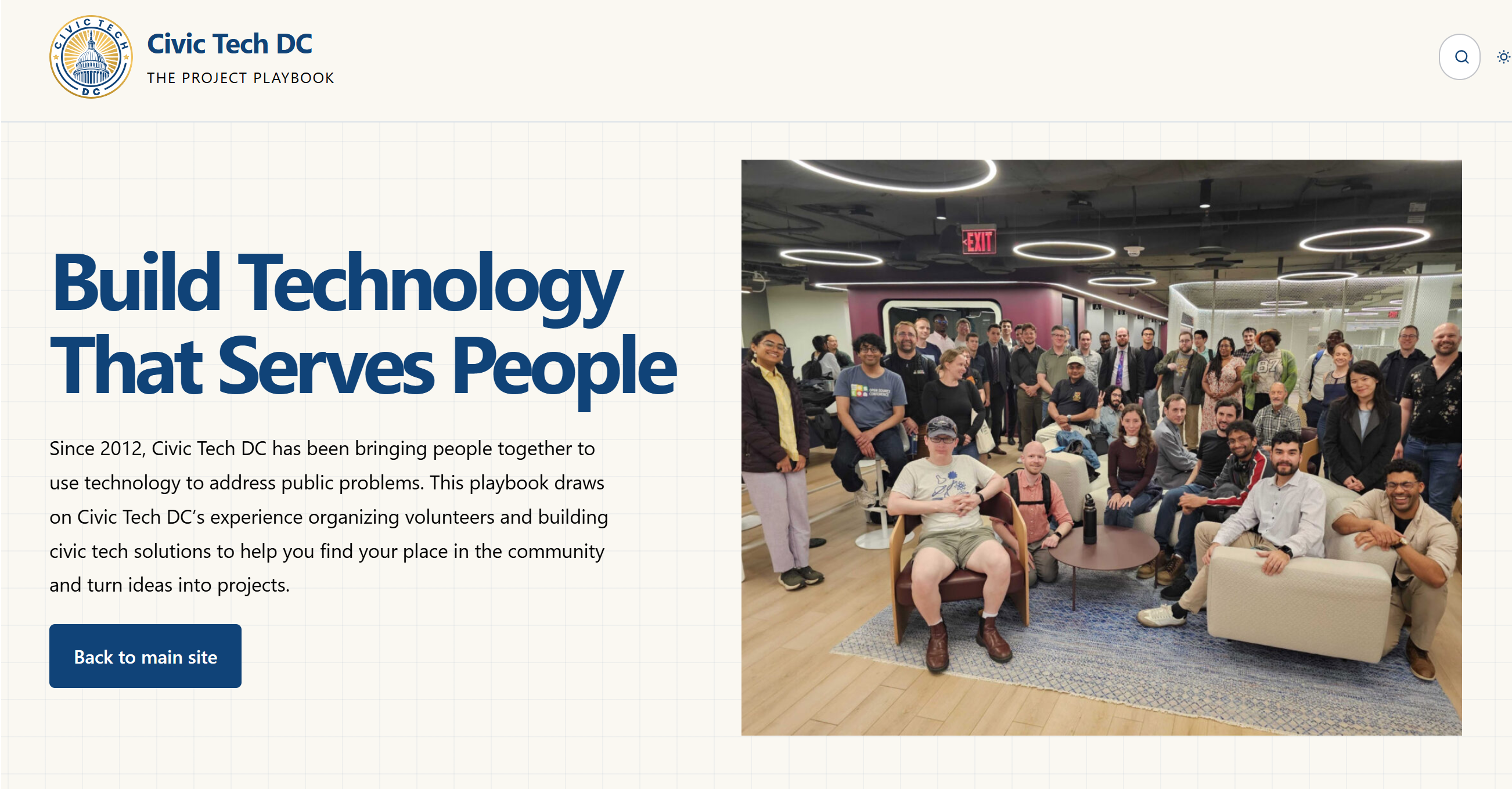
The playbook! It’s finally alive!!
It took a while to launch, but spurred by the DMV Super Meetup on October 16, I finally pulled together all the scattered writing I’d been working on and fleshed out the layout to show off at the meetup.
Back in March, I wrote a reflection on what I wanted the playbook to include. Specifically, I highlighted two things:
-
Different ways of getting involved. Some people come to Civic Tech DC looking to contribute to an existing project (contributors), while others have their own ideas they want to pursue (initiators). I wanted the playbook to offer resources for both.
-
More structure for our incubator model. We’ve always welcomed people with new ideas, but haven’t had a clear process for helping them turn those ideas into projects. I wanted to make it easier to go from an initial idea to a plan with milestones, community partners, and a team.
The playbook now includes both, along with quite a bit more! It’s organized into three main sections: Learn, Join, and Build.
The Learn section introduces civic tech and includes a reconstructed history of Civic Tech DC going back to 2012. The Join section helps newcomers find their place in the community, with different contribution pathways and guidance on making their first contribution.
The Build section is probably where I’ve spent the most time thinking through how we operate. There are now two separate tracks for people with ideas that are either ready to join Civic Tech DC as a official project (onboarding track) and ideas that still need more exploration (incubator track). The incubator resources walk through understanding the problem, finding the right people, and figuring out whether tech is even the right solution. I’ve also included Project Resources on tips and tricks for leading project nights and working with community partners.
One thing I wanted to be intentional about was not creating more structure just for the sake of it. Civic Tech DC is volunteer-driven, and part of what makes it work is that people have the flexibility to explore their interests. But having some shared guidance can make it easier for newcomers to get involved and for organizers to avoid answering the same questions over and over.
The playbook is still a work in progress, and I will continue to update it with feedback. But more than anything, I hope it becomes something the community contributes to and builds on as a open-source resource.
Check it out! here and the code can be found here.